
Opportunity
Expert
Sales Qualification Frameworks

Your sales team just finished a two-day methodology workshop. They got the certification. They practiced the role plays. They left the conference room nodding, energized, armed with a new framework. Ninety days later, nothing has changed. Reps are still winging discovery calls. Pipeline quality is still unpredictable. Quota attainment looks exactly like it did before the workshop, minus the money you spent on training.
This isn’t a training quality problem. It’s a training completeness problem.
Most sales methodology implementations focus on technique — teach the reps better questions, better frameworks, better closing sequences. And technique matters. But technique is only one-third of the equation. The Sandler Success Triangle identifies the two elements that sales leaders almost never coach: behavior and attitude. These are the invisible legs that determine whether technique actually gets used in the field or dies in a training binder.
Here’s the uncomfortable pattern: your reps already know how to run a good discovery call. They’ve been trained on Gap Selling, on MEDDIC, on consultative frameworks. They can execute the techniques in a role play. They just don’t do it on real calls — because something between the training room and the buyer’s conference room breaks down. The Sandler Success Triangle names that something.
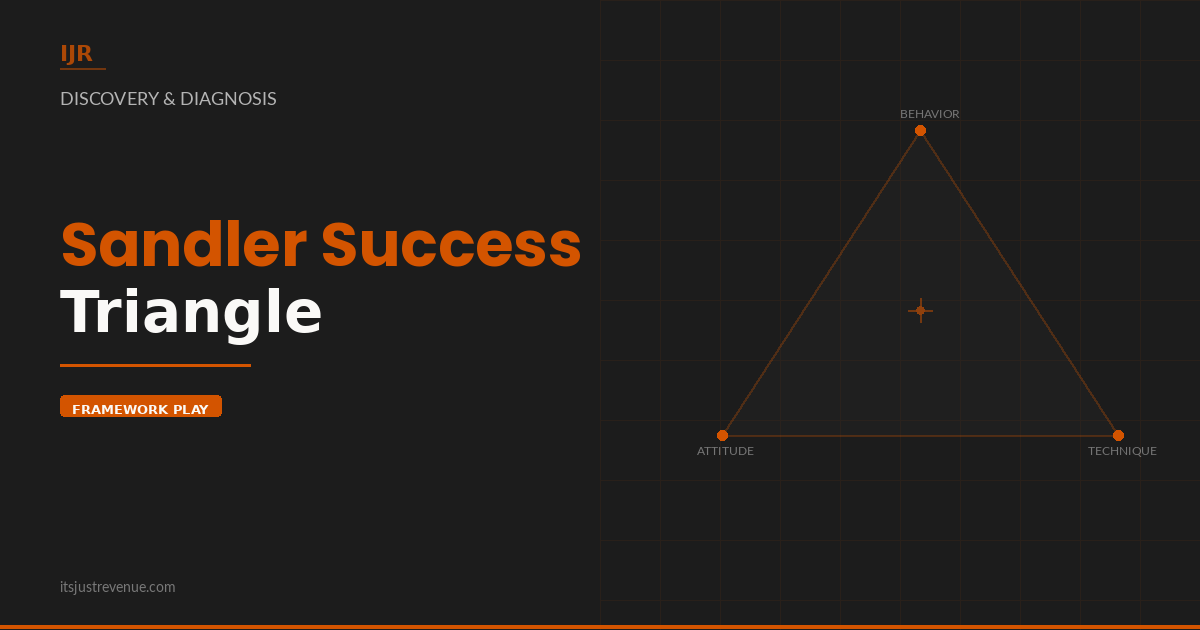
Behavior is what you do — the daily activities that compound into pipeline. Attitude is why you do it — the beliefs and identity that drive or block action. Technique is how you do it — the skills and frameworks everyone focuses on exclusively. When any one leg is weak, the whole triangle collapses. A rep with flawless technique but no prospecting discipline has a behavior problem. A rep who prospects consistently but freezes in C-suite conversations has an attitude problem. Training technique when the issue is attitude is like prescribing running shoes when the problem is a broken leg.
What is the Sandler Success Triangle?
The Sandler Success Triangle is a sales development framework built on three interdependent elements — Behavior, Attitude, and Technique — that must be developed together for sustainable performance improvement. When all three elements are coached in parallel rather than in isolation, teams see 15–25% quota attainment improvement within 90 days and significantly higher rep retention.
| Best For | Sales Managers, Account Executives, Sales Enablement Leaders |
| Deal Size | All (SMB through Enterprise) |
| Difficulty | Expert |
| Funnel Stage | Lead → Opportunity |
| Impact | Very High — 15–25% quota attainment improvement, measurable behavior change |
| Time to Execute | Extended (90-day implementation cycle with ongoing coaching) |
| AI Ready | Yes — behavior tracking, technique scoring, coaching recommendations |
Run this play when:
Don’t run when:
IJR take: The methodology theater version of the Sandler Triangle is a training deck that explains the three elements and then tests reps on definitions. The real version requires managers to diagnose which leg is weak for each individual rep and coach that specific gap. If your implementation doesn’t include a per-rep diagnostic, you’ve bought a framework poster, not a development system.
This is a Framework play, which means it provides a structural model with distinct components rather than sequential steps. The three elements of the triangle are interdependent — no single element works in isolation, and the weakest leg determines the triangle’s stability.
Behavior is the most visible and most coachable leg of the triangle. It’s the daily activity discipline that separates reps who build pipeline from reps who wait for it.
The mistake most managers make with behavior coaching: they track outputs (calls made, emails sent) instead of quality indicators (discovery calls with decision-maker access, proposals attached to validated pain). Activity volume without quality standards is just noise that looks productive in the CRM.
Non-negotiable behaviors to establish:
Set a behavior contract with each rep — not a quota, a contract. The difference: a quota is imposed. A contract is agreed upon. The rep commits to specific daily and weekly behaviors, and the manager commits to removing obstacles and providing resources. Both sides have accountability.
What good looks like:
The data delusion trap: CRM activity tracking tells you what the rep did. It doesn’t tell you why they didn’t do more. A rep who makes 30 calls a day but avoids calling above the director level has a behavior problem disguised as activity compliance. The behavior audit needs to measure what reps avoid, not just what they complete.
Attitude is the leg that makes sales leaders uncomfortable. It feels soft. It sounds like therapy. And it is the single most common reason trained reps underperform.
Attitude in the Sandler context isn’t about positivity or motivation. It’s about identity — the beliefs reps hold about themselves, their product, their market, and their buyers that either enable or block execution. A rep who believes “C-suite executives won’t take my call” won’t make C-suite calls regardless of technique training. A rep who believes “our pricing is too high” will discount before the buyer even objects.
Key attitude diagnostics:
Ask each rep these questions in a one-on-one coaching session. Their answers reveal which beliefs are limiting their behavior:
“What’s the highest-level executive you’ve personally called in the last 30 days? What stopped you from going higher?”
“When a deal stalls, what’s your first assumption about why? Is it about the buyer, or about you?”
“If I told you to double your average deal size for the next quarter, what’s the first thought that comes to mind?”
The answers tell you everything. If the rep immediately frames the constraint as external (“the market won’t support it,” “our product can’t compete at that level”), that’s an attitude gap. If they frame it as actionable (“I’d need to learn enterprise discovery,” “I’d need executive sponsors”), that’s technique — and it’s coachable quickly.
Sandler’s I-Can/I-Can’t exercise: Have each rep list 10 things they believe they “can’t” do in their current role. Then challenge each belief with evidence. “I can’t sell to the CFO” — have you tried? How many CFOs have you called? What happened? The exercise surfaces limiting beliefs that drive avoidance behaviors, and evidence-based challenge breaks the belief-to-behavior chain.
Technique is where every other training program starts and stops. Sandler’s insight was that technique is the final leg — the one that only matters when behavior and attitude are solid enough to support it.
That said, Sandler’s technique toolkit is exceptionally strong. The four core techniques every rep should master:
Up-Front Contract:
Set clear expectations at the start of every meeting — the agenda, the time, and the possible outcomes. “At the end of this call, one of three things will happen: we’ll agree there’s a fit and schedule next steps, we’ll agree there isn’t a fit and part as friends, or we’ll need more information. Any of those outcomes is fine. Does that work for you?” This eliminates the ambiguity that causes deals to stall in no-man’s land.
Pain Funnel:
Sandler’s questioning methodology for uncovering real business pain — not stated needs, but the consequences of inaction. Start broad (“Tell me more about that”) and funnel progressively deeper (“How long has that been a problem?” → “What have you tried?” → “Why do you think that didn’t work?” → “How much is this costing you?”). The pain funnel is the technique foundation for Gap Selling Discovery — both frameworks reach the same destination through slightly different paths.
Negative Reverse Selling:
Instead of pushing forward when a buyer shows resistance, pull back. “It sounds like this might not be a fit for where you are right now. Maybe we should hold off.” This removes pressure and, counterintuitively, increases buyer engagement because it eliminates the adversarial dynamic. Buyers chase what retreats.
Post-Sell System:
After the deal closes, reinforce the buying decision before buyer’s remorse sets in. A structured post-close communication that reaffirms the business case, introduces the implementation team, and sets expectations for the first 30 days. This isn’t customer success — it’s sales discipline that protects revenue from clawbacks and churn.
The triangle’s power isn’t in any single leg. It’s in the diagnosis of which leg is failing.
| Symptom | Likely Gap | Coaching Focus |
| Rep knows the framework but doesn’t use it on calls | Behavior | Activity contracts, accountability cadence |
| Rep prospects consistently but freezes in high-level conversations | Attitude | Belief identification, identity coaching |
| Rep is confident and active but conversations don’t advance | Technique | Skills training, call review, framework practice |
| Rep performance fluctuates wildly month to month | Attitude + Behavior | Resilience coaching, routine stabilization |
| Rep performs well individually but struggles in team selling | Attitude + Technique | Collaboration coaching, multi-threading practice |
| Metric | Target | What Most Teams Actually See |
| Quota attainment improvement | +15–25% within 90 days | +5–8% — because they only trained technique and skipped behavior/attitude |
| Behavior compliance rate | 90%+ adherence to contracts | 50–60% — because contracts aren’t enforced and managers don’t model the behavior |
| Attitude assessment improvement | +30 points from baseline | Not measured — because most teams don’t assess attitude at all |
| Technique certification pass rate | 80%+ of team | 70% — acceptable, but certification without behavior change is just a trophy |
| Sales cycle length reduction | 10–15% shorter | Unchanged — because reps still avoid the uncomfortable conversations that accelerate deals |
| Win rate improvement | +5–10 percentage points | +2–3 points — because technique without confidence produces hesitant execution |
| Pipeline activity growth | +20% new opportunity creation | Flat — because prospecting behavior isn’t coached with the same rigor as closing technique |
| Team retention rate | 90%+ over 6 months | 70–80% — because reps who feel unsupported by coaching leave for companies that invest in development |
The gap between target and reality exists because most Sandler implementations are actually technique training with a triangle slide in the deck. Real triangle implementation requires individual diagnosis, weekly coaching, and management commitment that most organizations aren’t prepared to sustain.
“Our team already knows Sandler. We don’t need another training program.”
This objection actually proves the point. If the team knows Sandler and quota attainment hasn’t improved, the issue isn’t knowledge — it’s application. The triangle framework isn’t about teaching new techniques. It’s about diagnosing why existing techniques aren’t being used. Ask: “If your reps can explain the Pain Funnel in a role play, why aren’t they using it on real calls?” That gap between knowing and doing is exactly what the behavior and attitude legs address.
Been there: At Emarsys, we had reps who could recite sales methodology frameworks from memory. Certification scores were excellent. But call recordings told a completely different story — discovery questions disappeared the moment a buyer pushed back. The technique was there. The confidence to use it under pressure wasn’t. That’s an attitude gap, and no amount of re-training fixes it.
“We can’t afford to pull reps out of selling for 90 days.”
You’re not pulling them out. The implementation happens during normal selling activities — 15-minute daily behavior commitments and 30-minute weekly coaching sessions. The total investment is roughly 3–4 hours per month per rep. Compare that to the cost of a rep who operates at 60% of quota for an entire year because nobody diagnosed why they were underperforming.
Been there: The “can’t afford the time” objection usually comes from the same leaders who spend 5+ hours per week in forecast calls reviewing the same stalled deals. Forecast reviews are retrospective — they tell you what happened. Triangle coaching is preventive — it changes what happens next. The time investment is a reallocation, not an addition.
“Attitude coaching feels too soft for our culture.”
It sounds soft until you see the numbers. A rep with a limiting belief about their ability to sell to enterprise buyers will self-select out of every enterprise opportunity. That’s not a technique gap or a behavior gap — it’s an attitude gap that’s costing you pipeline. The “soft” coaching conversation that challenges that belief can unlock an entire tier of deal sizes the rep was unconsciously avoiding.
Been there: I managed a team where our best technical seller consistently avoided deals above $100K. Technique was flawless. Behavior metrics were strong on smaller deals. Turns out, they believed enterprise buyers would see through them — classic imposter syndrome. Two months of targeted coaching, one executive sponsor introduction, and one successful close later, their average deal size doubled. Nothing about their skills changed. Everything about their self-belief did.
“Our managers don’t have time for weekly coaching.”
Then your managers are doing the wrong work. A sales manager’s primary job is developing rep capability, not running reports or sitting in forecast calls. If managers don’t have time for 30-minute weekly coaching sessions, the organizational priority structure needs examination — not the coaching framework. The template takes 10 minutes to prep and 30 minutes to execute. It’s the highest-ROI 40 minutes a manager spends all week.
Been there: When we implemented weekly triangle coaching, the first thing we cut was the all-hands pipeline review meeting. Managers were spending three hours a week presenting pipeline slides to each other. We replaced it with a 15-minute async summary and gave the time back for coaching. Forecast accuracy actually improved because managers were closer to their reps’ deals through coaching, not pipeline theater.
“We tried this and nothing changed.”
I’d bet the implementation stopped at the workshop. Sustainable behavior change requires sustained coaching — not a kickoff event followed by an email reminder. The question isn’t whether the framework works. It’s whether your organization committed to the coaching cadence long enough for behavior change to stick. Ninety days is the minimum. Most “failed” implementations lasted 30 days before competing priorities took over.
Been there: Every methodology I’ve seen fail had the same pattern — enthusiastic launch, disciplined first month, sporadic second month, abandoned by month three. The teams where it worked had one thing in common: a leader who protected the coaching cadence against every other demand for that time. The methodology doesn’t fail. The commitment does.
Sales Development Representatives (SDRs):
Behavior is the dominant coaching leg for SDRs. Their job is activity — calls, emails, meetings set — and behavior compliance drives output directly. Attitude coaching focuses on resilience: SDRs face 95%+ rejection rates daily, and the reps who flame out aren’t lacking technique. They’re lacking the emotional architecture to process rejection without internalizing it. Technique training covers discovery questioning and qualification, but keep it focused — SDRs don’t need the full consultative toolkit yet.
Account Executives:
Technique and attitude carry equal weight. AEs need sophisticated discovery and negotiation skills, but they also need the confidence to apply them in high-stakes conversations. The most common AE attitude gap: fear of asking for the close. They run beautiful discovery, build compelling proposals, and then wait for the buyer to decide instead of creating the decision moment. Coach the attitude (“you’ve earned the right to ask”) alongside the technique (“here’s how to ask”).
Sales Managers / Frontline Leaders:
Managers’ triangle looks different from reps’. Their behavior is coaching frequency and quality. Their attitude is belief in team potential — a manager who’s given up on a rep will stop investing coaching time, and the rep’s performance will confirm the bias. Their technique is coaching methodology itself — running effective one-on-ones, delivering feedback, facilitating performance conversations. Train managers on the triangle before rolling it out to reps.
Directors / VPs:
The triangle at leadership level focuses on strategic behavior (cross-functional collaboration, board communication, talent development) and attitude (conviction in market opportunity during downturns, growth mindset about team capability). Technique becomes stakeholder alignment, organizational design, and sales strategy execution. Coach in peer cohorts rather than top-down.
Enterprise SaaS: Extend the implementation to 60–90 days. Enterprise deal cycles mean behavior changes take longer to produce visible results. Add multi-threading technique and executive presence as coaching priorities. The attitude gap here is often confidence selling against entrenched incumbents.
Financial Services: Integrate compliance awareness into behavior contracts. Technique training must include regulatory discussion fluency. The unique attitude challenge: reps in financial services often struggle to position themselves as advisors rather than vendors. Coach identity, not just skills.
Healthcare Technology: Plan for 12+ month implementation cycles. Clinical buyers require extreme patience, and the attitude coaching must address the gap between sales urgency and clinical decision timelines. Behavior coaching focuses on relationship depth over activity volume.
Mid-Market Services: Focus heavily on attitude — overcoming imposter syndrome when selling to sophisticated enterprise buyers from a mid-market company. Behavior discipline around new business prospecting is critical because services teams tend to default to account management over hunting.
AI transforms the triangle from a quarterly assessment into a real-time coaching system. The three elements become continuously measurable instead of periodically evaluated.
1. Automated Behavior Tracking
AI analyzes CRM activity logs, email engagement data, and calendar patterns to score behavior compliance daily — not weekly. It surfaces trends before they become problems: “Rep X’s prospecting activity dropped 40% this week” or “Rep Y hasn’t called above the director level in 30 days.” Managers get actionable alerts instead of waiting for the monthly review to discover a behavior gap.
2. Technique Evaluation at Scale
AI-powered conversation intelligence (Gong, Chorus, Clari) evaluates rep technique across every recorded call — question quality, talk-to-listen ratio, objection handling, Pain Funnel execution, Up-Front Contract discipline. Instead of a manager reviewing two calls per week per rep, AI scores every call and surfaces the ones that need coaching attention. This moves technique coaching from sample-based to data-comprehensive.
3. Attitude Signal Detection
This is the frontier. AI can detect attitude signals through language pattern analysis — declining confidence markers, increased hedging language, reduced assertiveness in closing conversations. While AI can’t replace the coaching conversation, it can flag which reps need it and suggest what to focus on based on behavioral evidence.
4. Personalized Coaching Recommendations
AI analyzes each rep’s performance data across all three triangle legs and recommends the highest-impact coaching topic for the next session. “Rep A’s technique scores are strong but prospecting behavior dropped — focus on behavior this week” or “Rep B’s confidence markers declined after losing the enterprise deal — attitude coaching needed.” This moves coaching from manager intuition to data-informed diagnosis.
Ready-to-use prompt:
Analyze the following sales call transcript against Sandler methodology
principles. Evaluate:

1. UP-FRONT CONTRACT: Did the rep set clear call objectives, time
   boundaries, and possible outcomes at the start?
2. PAIN FUNNEL: How deep did the rep probe into the prospect’s
   business problems? Count the levels of questioning depth.
3. TALK-TO-LISTEN RATIO: What percentage of the call was the rep
   talking vs. listening? Target is 30/70 or better.
4. NEGATIVE REVERSE: Did the rep acknowledge buyer reluctance
   without pushing through objections?
5. CLOSE ATTEMPT: Did the rep create a clear decision moment or
   leave the outcome ambiguous?

For each element, provide:
- Specific quotes from the transcript
- A 1-5 mastery score
- One coaching recommendation

Then diagnose: Is the primary gap Behavior (not doing it),
Attitude (not believing they can), or Technique (not knowing how)?
Recommend the single coaching focus for this rep’s next session.
Tools that enable this: Gong/Chorus (conversation intelligence and technique scoring), Salesloft/Outreach (behavior tracking and sequence compliance), Clari (deal health and forecast accuracy), HubSpot/Salesforce (activity logging and pipeline tracking), 15Five/Lattice (coaching cadence management).
That Sandler certification on the wall? It means your team passed a technique test. It doesn’t mean they changed how they sell.
If you remember nothing else: the triangle doesn’t tell you what to sell. It tells you why your team isn’t selling what they already know how to sell. Every stalled quota, every missed forecast, every “I don’t know why that deal died” conversation has a root cause in one of three places — the rep isn’t doing the work (behavior), doesn’t believe they can (attitude), or doesn’t know how (technique). Training only fixes the third one.
The teams hitting quota consistently aren’t the ones with the best technique training budget. They’re the ones whose managers diagnose which leg is weak for each individual rep and coach that specific gap every week. The triangle is a diagnostic tool, not a training program. Use it like one.
If your team has been through methodology training and performance hasn’t changed, stop buying more training. Start diagnosing instead. The framework is already in their heads. The question is which leg of the triangle is keeping it there instead of putting it into practice.
What is the Sandler Success Triangle?
The Sandler Success Triangle is a sales development framework with three interdependent elements: Behavior (what you do — daily activities and discipline), Attitude (why you do it — beliefs and identity that drive or block action), and Technique (how you do it — skills and frameworks). Unlike most sales training that focuses exclusively on technique, the triangle requires all three elements to be coached in parallel for sustainable performance improvement.
How long does it take to implement the Sandler Success Triangle?
Minimum 90 days for measurable results, with ongoing coaching required to sustain behavior change. The first 30 days establish behavior contracts and baseline assessments. Days 30–60 focus on attitude identification and targeted coaching. Days 60–90 layer technique refinement on top of stabilized behavior and attitude foundations. Most “failed” implementations lasted 30 days before competing priorities took over — the framework works when the commitment does.
Can the Sandler Triangle work alongside other sales methodologies?
Yes — and it should. The triangle isn’t a competing methodology. It’s a development framework that makes other methodologies stick. Teams running Gap Selling, MEDDIC, Challenger, or any consultative framework can use the triangle to diagnose why reps aren’t applying those techniques consistently. The triangle explains the knowing-doing gap that every methodology encounters.
How do you measure attitude in sales reps?
Through structured diagnostic conversations, not surveys. Ask reps to identify their highest-level call in the last month, their first assumption when a deal stalls, and their reaction to being asked to double their deal size. The answers reveal limiting beliefs. Formal psychometric assessments provide a baseline score, but the real measurement happens in weekly coaching sessions where managers track which beliefs are shifting and which are persisting.
What’s the most common mistake in Sandler Triangle implementation?
Treating it as a training event instead of a coaching system. The workshop teaches the framework. The coaching changes the behavior. Organizations that run a two-day Sandler workshop and expect behavior change are making the same mistake as companies that buy gym memberships and expect fitness. The membership gives you access. The daily habit gives you results. Weekly coaching is the daily habit of the Sandler Triangle.
About the Author
Brandon Briggs is a fractional CRO and the founder of It’s Just Revenue. He’s built revenue engines at six companies — including Bold Commerce, Emarsys/SAP, Dotdigital, and Annex Cloud — scaling teams from zero to eight-figure ARR and helping build partner ecosystems north of $250M. He now helps growth-stage companies fix the gap between activity and revenue. He’s also building Tempreon — an intelligence layer that captures how operators decide and travels with them across every AI tool they use. Connect on LinkedIn.
Part of the It’s Just Revenue Sales Plays Library — practical frameworks for revenue teams who want to stop the theater and start closing.
Want to dig deeper? Book a coaching session and we'll work through your specific situation.
Book a Session